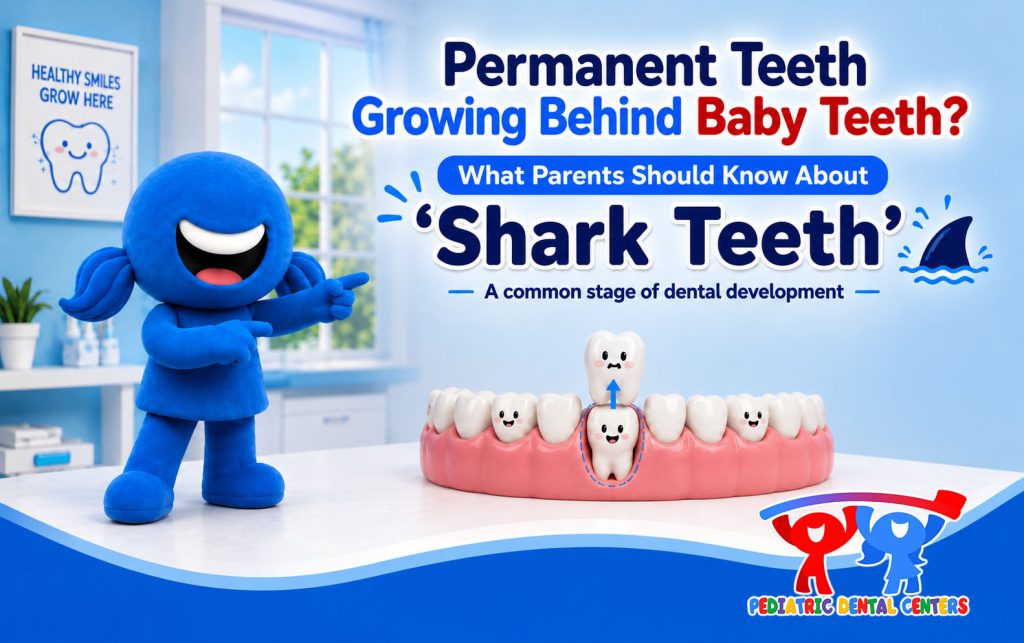
Permanent Teeth Growing Behind Baby Teeth? What Parents…
Your child smiles, and suddenly you notice something unexpected: a second row of teeth. A permanent tooth is coming in behind a baby tooth that…
Home » Services » Emergency dentistry » Loose or Dislodged Tooth
Prompt pediatric emergency care for teeth that become loose or shift out of position after an injury.
At Pediatric Dental Centers, we provide prompt care for kids and teens with loose or dislodged teeth caused by falls, sports injuries, or other dental trauma. Our pediatric dental team carefully evaluates the tooth, surrounding tissues, and bite to determine the best way to stabilize and protect your child’s smile.
Families searching for a pediatric emergency dentist near them trust Pediatric Dental Centers for prompt, gentle care after dental trauma. Our team evaluates the injured tooth and surrounding tissues to determine the appropriate treatment and follow-up for your child.


If your child’s tooth became loose or shifted after a fall, sports injury, or other accident, don’t wait for symptoms to get worse. Prompt evaluation can help our pediatric dental team identify the type of injury and determine the appropriate treatment to protect the tooth and surrounding tissues.
A dislodged or luxated tooth is a tooth that has become loose or moved from its normal position after trauma but has not been completely knocked out. The tooth may shift forward, backward, sideways, inward, or partially out of the socket depending on the type of injury.
Avoid repeatedly touching or moving the injured tooth and contact a pediatric dentist immediately. Do not try to force a displaced tooth back into position yourself. Prompt evaluation allows the dentist to identify the injury and determine whether the tooth needs observation, repositioning, stabilization, or another treatment.
No. A baby tooth that becomes gradually loose as part of normal development is usually expected. However, a tooth that suddenly becomes loose or changes position after a fall, impact, or other injury should be professionally evaluated as soon as possible. Traumatic injuries to primary and permanent teeth require different management.
Often, treatment aims to preserve the injured permanent tooth, but the outcome depends on factors such as the type and severity of injury, root development, surrounding tissue damage, and how quickly treatment begins. Continued dental follow-up is also important because some complications may develop after the initial injury.
Dental X-rays may be recommended to determine the position of the injured tooth and evaluate the root, surrounding bone, and nearby structures. The need for imaging depends on the type of trauma and the dentist’s clinical findings.
The dentist will examine the injured tooth, gums, bite, and surrounding tissues and may take dental X-rays. Depending on the type of luxation, treatment may involve monitoring the tooth, repositioning or stabilizing it, and scheduling follow-up visits to monitor healing and tooth vitality.
Want more about Pediatric Dental Center?
Your child smiles, and suddenly you notice something unexpected: a second row of teeth. A permanent tooth is coming in behind a baby tooth that…
A permanent tooth has just erupted, but instead of looking uniformly white, part of it appears creamy white, yellow, or even brown. Parents understandably wonder:…
Many parents notice that their child sleeps with their mouth open, breathes through the mouth during the day, or frequently wakes up with dry lips…