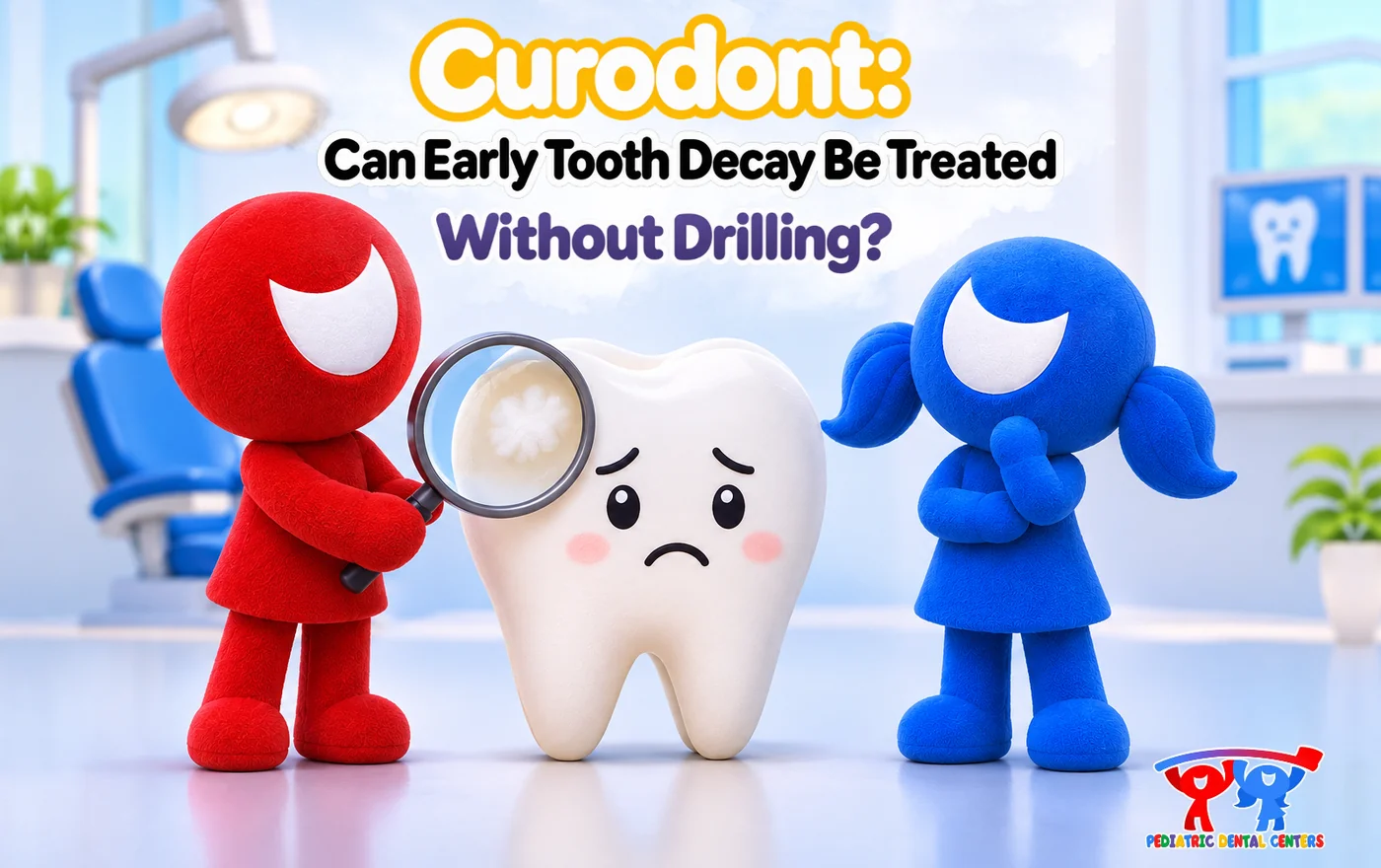
Hearing that your child has tooth decay can be stressful. But when decay is caught early, a filling may not be the only option.
Curodont is a professionally applied treatment that can help remineralize early tooth decay before a visible hole develops. For selected teeth, it offers an opportunity to preserve healthy tooth structure and potentially avoid or delay a filling.
What Is Curodont?
Curodont Repair Fluoride Plus is designed for early, non-cavitated decay—areas where the tooth has lost minerals but its surface has not broken down into a cavity.
Its peptide-based technology supports mineral deposition within the affected enamel. Together with fluoride and minerals naturally present in saliva, it helps strengthen the weakened area over time. It does not grow a new tooth or replace missing tooth structure.
Which Children May Benefit?
A pediatric dentist may consider Curodont for certain early lesions on baby teeth or permanent teeth, including some decay-related white spots and early lesions between teeth.
Not every white spot is decay, and not every cavity qualifies. Your child’s dentist must evaluate the tooth’s surface, lesion activity, and depth, using X-rays when appropriate. Age and the ability to cooperate with treatment also matter.
Does Treatment Require Drilling or a Shot?
For an appropriate early lesion, Curodont is applied directly to the prepared tooth surface without drilling away tooth structure. A numbing injection is generally unnecessary for the application itself.
The goal is to help the tooth recover minerals gradually. Follow-up examinations are needed to determine whether the lesion is becoming inactive or continuing to progress. Treatment is not a guarantee that the tooth will never need a filling.
What Does the Research Show?
Clinical studies have reported promising results. A small randomized trial found greater improvement in measurements of early lesions with Curodont Repair Fluoride Plus than with fluoride varnish alone over six months. Another trial involving preschool children reported favorable results for white spot lesions in baby teeth using repeated applications over a defined treatment schedule.
These findings support Curodont as an additional treatment option. They do not mean it works for every child or replaces all other approaches. Results depend on the lesion, treatment protocol, and continuing control of the factors causing decay.
Can It Replace a Filling?
Curodont cannot fill an existing hole or rebuild a broken tooth. Teeth with more advanced decay may require a filling, crown, or another treatment selected by the dentist. Early evaluation gives families more opportunities to consider conservative care.
Ask About Your Child’s Options
If your child has a white spot or an area being monitored for early decay, ask:
- Is the tooth surface still intact?
- Could this area benefit from remineralization treatment?
- What alternatives are appropriate?
- How will we know whether treatment is working?
At Pediatric Dental Centers, a dental examination is the first step toward understanding your child’s needs. Schedule a visit to discuss early tooth decay, prevention, and the treatment options appropriate for your child.
Book an appointment online, find your nearest Pediatric Dental Centers location, or call us at (786) 410-3018.
This article provides general educational information and is not a substitute for an examination. Only your child’s dentist can determine whether Curodont is appropriate for a specific tooth.
Medically reviewed by Dr. Enrique Acosta, DDS, board-certified pediatric dentist and founder of Pediatric Dental Centers. Last reviewed: November 16, 2026.