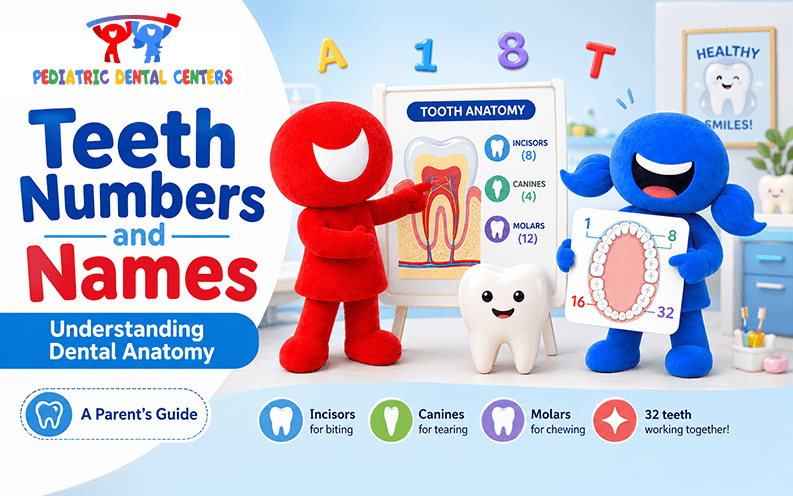
Have you ever heard your child’s dentist say something like “tooth number 8” or “tooth letter K” and wondered what it meant?
Dentists use a standardized system of numbers and letters to identify each tooth. This makes it easier to record cavities, monitor tooth development, explain treatments, and communicate accurately with parents and other dental professionals.
For families, understanding the basics of teeth numbers and names can make dental appointments feel less confusing. It can also help parents better understand how their child’s smile develops from baby teeth to permanent teeth.
How Many Teeth Do Children Have?
Children normally develop two sets of teeth during their lifetime:
- Primary teeth, also called baby teeth
- Permanent teeth, also called adult teeth
A complete set of primary teeth contains 20 teeth—10 in the upper jaw and 10 in the lower jaw.
Most adults can develop up to 32 permanent teeth, including four wisdom teeth. However, children and teenagers usually have fewer permanent teeth while their smiles are still developing.
The transition from primary teeth to permanent teeth does not happen all at once. Children often have a combination of baby and permanent teeth for several years. This stage is called mixed dentition.
According to the American Academy of Pediatric Dentistry, the first permanent molars and lower permanent incisors commonly begin appearing at approximately six years of age, although normal development can vary from child to child.
Why Do Dentists Use Teeth Numbers and Letters?
A tooth chart gives every tooth a specific identifier.
Instead of saying “the back tooth on the upper right side,” the dentist can identify the exact tooth using a number or letter.
This system helps dental teams:
- Record cavities and dental restorations
- Identify chipped or injured teeth
- Monitor permanent teeth as they erupt
- Plan extractions and restorative treatments
- Track orthodontic development
- Review dental X-rays
- Communicate clearly about your child’s care
The American Dental Association’s Universal Tooth Designation System uses numbers 1 through 32 for permanent teeth and letters A through T for primary teeth.
How Are Permanent Teeth Numbered?
Permanent teeth are identified using numbers from 1 to 32.
The numbering begins with the upper-right wisdom tooth from the patient’s perspective. That tooth is number 1.
The sequence continues across the upper jaw:
- Tooth #1: Upper-right third molar or wisdom tooth
- Tooth #8: Upper-right central incisor
- Tooth #9: Upper-left central incisor
- Tooth #16: Upper-left third molar or wisdom tooth
The numbering then moves to the lower-left side:
- Tooth #17: Lower-left third molar or wisdom tooth
- Tooth #24: Lower-left central incisor
- Tooth #25: Lower-right central incisor
- Tooth #32: Lower-right third molar or wisdom tooth
In other words, permanent teeth are numbered from the patient’s upper right to upper left, then from the lower left to lower right.
Permanent Teeth Number Chart
| Permanent teeth | Tooth numbers |
|---|---|
| Upper-right molars | 1–3 |
| Upper-right premolars | 4–5 |
| Upper-right canine | 6 |
| Upper-right incisors | 7–8 |
| Upper-left incisors | 9–10 |
| Upper-left canine | 11 |
| Upper-left premolars | 12–13 |
| Upper-left molars | 14–16 |
| Lower-left molars | 17–19 |
| Lower-left premolars | 20–21 |
| Lower-left canine | 22 |
| Lower-left incisors | 23–24 |
| Lower-right incisors | 25–26 |
| Lower-right canine | 27 |
| Lower-right premolars | 28–29 |
| Lower-right molars | 30–32 |
Not every child or adult has all 32 permanent teeth. Wisdom teeth usually develop later and may not erupt until the late teenage years or early adulthood. Some people never develop one or more wisdom teeth.
How Are Baby Teeth Identified?
Primary teeth are identified using capital letters from A through T instead of numbers.
The sequence begins with the child’s upper-right second primary molar:
- Tooth A: Upper-right second molar
- Tooth E: Upper-right central incisor
- Tooth F: Upper-left central incisor
- Tooth J: Upper-left second molar
- Tooth K: Lower-left second molar
- Tooth O: Lower-left central incisor
- Tooth P: Lower-right central incisor
- Tooth T: Lower-right second molar
The letters move across the upper jaw from right to left and then continue across the lower jaw from left to right.
Primary Teeth Letter Chart
| Primary teeth | Tooth letters |
|---|---|
| Upper-right second molar | A |
| Upper-right first molar | B |
| Upper-right canine | C |
| Upper-right lateral incisor | D |
| Upper-right central incisor | E |
| Upper-left central incisor | F |
| Upper-left lateral incisor | G |
| Upper-left canine | H |
| Upper-left first molar | I |
| Upper-left second molar | J |
| Lower-left second molar | K |
| Lower-left first molar | L |
| Lower-left canine | M |
| Lower-left lateral incisor | N |
| Lower-left central incisor | O |
| Lower-right central incisor | P |
| Lower-right lateral incisor | Q |
| Lower-right canine | R |
| Lower-right first molar | S |
| Lower-right second molar | T |
What Are the Different Types of Teeth?
Teeth are not all shaped the same because they perform different jobs.
A child’s smile may include incisors, canines and molars. Premolars appear only in the permanent set of teeth.
Incisors
Incisors are the flat, relatively sharp teeth located at the front of the mouth.
Children have eight primary incisors:
- Four upper incisors
- Four lower incisors
Permanent dentition also includes eight incisors.
Incisors help children bite into and cut foods. Because they are positioned at the front of the mouth, they also have a significant effect on the appearance of the smile.
Canines
Canines are the pointed teeth next to the lateral incisors. They are sometimes called cuspids.
Children and adults generally have four canines:
- Two in the upper jaw
- Two in the lower jaw
Their pointed shape helps tear food. Canines also help guide the teeth when the lower jaw moves from side to side.
Premolars
Premolars, also called bicuspids, are located between the canines and permanent molars.
Primary dentition does not contain premolars. Instead, the primary molars eventually fall out and are replaced by permanent premolars.
A complete permanent smile normally contains eight premolars. These teeth help crush and grind food before it is swallowed.
Molars
Molars are the broad teeth located toward the back of the mouth. Their larger chewing surfaces help grind food into smaller pieces.
Children normally have eight primary molars. These baby molars preserve space for the permanent teeth developing underneath them.
Permanent dentition can contain up to 12 molars, including the four wisdom teeth.
Do Baby Teeth Really Matter?
Baby teeth are temporary, but they still play an important role in a child’s development.
Primary teeth help children:
- Bite and chew food
- Speak clearly
- Maintain space for permanent teeth
- Support normal jaw development
- Develop confidence in their smile
A cavity or infection in a primary tooth should not be ignored simply because the tooth will eventually fall out. Untreated dental problems can cause pain, interfere with eating and affect the tissues surrounding developing permanent teeth.
Pediatric Dental Centers provides preventive, restorative and emergency dental care designed specifically for children and teenagers. Services include dental exams, cleanings, fluoride treatments, sealants, cavity fillings and space maintainers.
What Are the Main Parts of a Tooth?
Each tooth contains several layers and structures.
Crown
The crown is the visible portion of the tooth above the gumline. Its shape varies depending on whether the tooth is an incisor, canine, premolar or molar.
Enamel
Enamel is the hard outer covering of the crown. It protects the internal parts of the tooth from daily chewing forces and temperature changes.
Although enamel is very strong, it can still be damaged by cavities, injuries and frequent exposure to sugar or acidic drinks.
Dentin
Dentin is located underneath the enamel. It forms most of the tooth’s structure and is softer than enamel.
When enamel becomes damaged or worn, exposed dentin can make a tooth more sensitive.
Pulp
The pulp is the innermost part of the tooth. It contains nerves, blood vessels and connective tissue.
A deep cavity or dental injury may allow bacteria to reach the pulp, potentially causing pain or infection.
Root
The root is the portion of the tooth located below the gumline. It helps anchor the tooth within the jaw.
Primary tooth roots gradually dissolve as the permanent teeth underneath prepare to erupt. This process allows baby teeth to loosen and eventually fall out.
Gums
The gums surround and help protect the teeth and supporting structures. Healthy gums generally fit closely around the teeth without persistent swelling or bleeding.
What Is Mixed Dentition?
Mixed dentition is the developmental stage when a child has both primary and permanent teeth.
During this period, parents may notice:
- Loose baby teeth
- Permanent teeth appearing behind baby teeth
- Temporary spacing between teeth
- Newly erupted teeth that appear larger or more yellow
- Changes in the child’s bite
- Crowding as permanent teeth emerge
Some changes are a normal part of dental development. Others may need to be evaluated by a pediatric dentist or orthodontist.
Regular dental examinations allow the dental team to monitor the sequence of tooth loss and eruption. They can also identify crowding, missing teeth, extra teeth, delayed eruption and bite concerns.
Why Might a Permanent Tooth Look More Yellow?
Parents sometimes become concerned when a permanent tooth appears more yellow than the neighboring baby teeth.
Permanent teeth naturally contain more dentin and may appear slightly darker or more yellow than primary teeth. The difference can look especially noticeable when a new permanent tooth is positioned beside bright-white baby teeth.
However, a tooth that becomes suddenly dark, gray or discolored—especially after an injury—should be evaluated by a dentist.
How Can Understanding Tooth Numbers Help Parents?
Knowing every number and letter is not necessary. However, understanding the basic system can make conversations with your child’s dental team easier.
For example, when the dentist explains that tooth “S” has a cavity, you will know they are talking about a lower-right primary molar. If the team discusses tooth “30,” they are referring to a lower-right permanent first molar.
Parents can use this information to:
- Ask clearer questions
- Understand dental treatment plans
- Follow recommendations after an injury
- Monitor newly erupting teeth
- Help older children understand their own dental care
Helping Your Child Care for Every Tooth
Tooth charts can also help families establish a consistent brushing routine.
Encourage your child to brush systematically rather than moving the toothbrush randomly around the mouth. For example, they can clean:
- The outside surfaces of the upper teeth
- The inside surfaces of the upper teeth
- The chewing surfaces of the upper teeth
- The outside surfaces of the lower teeth
- The inside surfaces of the lower teeth
- The chewing surfaces of the lower teeth
Parents should provide hands-on help or supervision until the child can brush every area effectively on their own.
Regular dental exams and professional cleanings also allow the pediatric dental team to check areas that may be difficult for children to clean at home.
Pediatric Dental Care for Growing Smiles
Your child’s teeth change significantly from infancy through adolescence. Pediatric Dental Centers provides comprehensive dental and orthodontic care throughout these important stages.
Families choose our team for:
- Kid-friendly dental offices
- Preventive and restorative dentistry
- Early orthodontic assessments
- Emergency dental care
- Specialized care for children
- Multiple locations across Miami-Dade and Broward
- Saturday availability
- Same-week appointments
- Medicaid and most PPO plans accepted
Pediatric Dental Centers has cared for South Florida smiles for more than 18 years and provides pediatric dentistry and orthodontics in a welcoming environment designed for children.
Schedule Your Child’s Dental Appointment
Understanding teeth numbers and names can help you follow your child’s changing smile, but regular dental examinations remain the best way to monitor dental growth and development.
Our pediatric dental team can identify cavities, evaluate newly erupting teeth and provide personalized recommendations for your child.
Schedule an appointment with Pediatric Dental Centers today.
Call: (786) 410-3018
Frequently Asked Questions
How many baby teeth do children have?
Children normally develop 20 primary teeth: 10 in the upper jaw and 10 in the lower jaw.
Are baby teeth numbered?
In the Universal Tooth Designation System, primary teeth are identified with letters A through T. Permanent teeth are identified with numbers 1 through 32.
At what age do children start losing baby teeth?
Many children begin losing primary teeth at approximately six or seven years old. However, the timing and order can vary. The AAPD’s growth and development chart shows that lower central incisors commonly exfoliate around ages six to seven, while some primary canines and molars remain until approximately ages nine to thirteen.
Do children have premolars?
Primary dentition does not include premolars. Permanent premolars eventually replace the primary molars.
Why does my child have two rows of teeth?
A permanent tooth may occasionally begin erupting behind a primary tooth that has not fallen out yet. This is sometimes informally called a “shark tooth.” A pediatric dentist can determine whether the primary tooth is likely to loosen naturally or whether treatment is needed.
What should I do if my child injures a tooth?
Contact a pediatric dentist as soon as possible. The appropriate response depends on whether the injured tooth is primary or permanent and whether it is chipped, loose, displaced or completely knocked out.
How often should my child visit the dentist?
Your child’s dentist will recommend a schedule based on their age, dental development and cavity risk. Regular visits allow the dental team to monitor tooth eruption, oral hygiene and developing dental concerns.