When parents hear that a baby tooth needs to be removed, one of the first questions they ask is:
“It’s just a baby tooth. Won’t the permanent tooth simply grow in later?”
The answer is not always.
Baby teeth play a much larger role than simply helping children chew and smile. They act as natural placeholders, preserving the exact amount of space needed for the permanent teeth that will eventually erupt. When certain baby teeth are lost too early because of severe decay, infection, trauma, or other dental problems, the surrounding teeth can begin shifting into the empty space within a relatively short period. This movement may block the eruption of the permanent tooth and contribute to crowding, bite problems, and the need for more extensive orthodontic treatment later. The American Academy of Pediatric Dentistry (AAPD) recommends evaluating children for space maintenance when premature loss of primary teeth occurs and the clinical situation indicates a risk of space loss.
Fortunately, pediatric dentists have an effective solution called a space maintainer.
What Is a Space Maintainer?
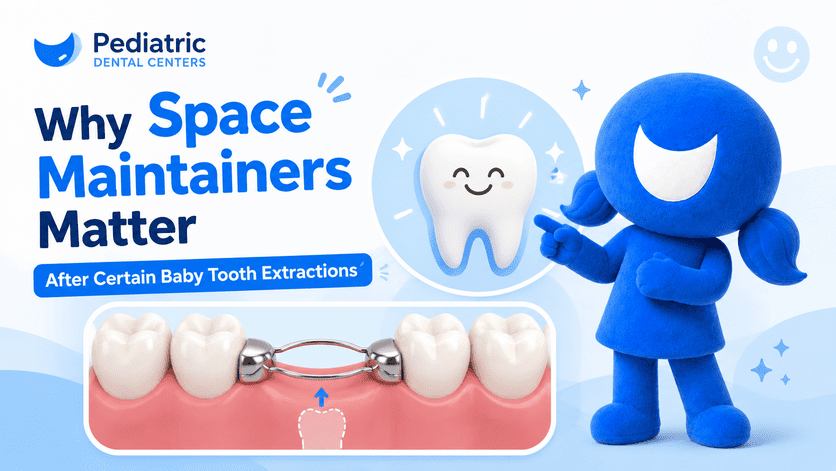
A space maintainer is a small custom-made dental appliance designed to keep the proper amount of space open after the premature loss of certain baby teeth.
It acts like a placeholder until the permanent tooth is ready to erupt naturally.
Depending on your child’s age and which tooth was removed, the appliance may be:
- Band and loop space maintainer
- Distal shoe space maintainer
- Lingual holding arch
- Nance appliance
- Removable space maintainer (in selected cases)
Your pediatric dentist will determine which appliance is most appropriate based on your child’s stage of dental development and overall oral health.
Why Are Baby Teeth So Important?
Many people underestimate the importance of primary teeth because they eventually fall out.
In reality, baby teeth perform several essential functions:
- Guide permanent teeth into the correct position
- Maintain proper spacing in the dental arches
- Help children chew comfortably
- Support normal speech development
- Promote healthy jaw growth
- Contribute to facial development
- Build confidence with a healthy smile
When a baby tooth is lost before its natural time, these important functions may be disrupted.
What Happens If the Space Is Not Maintained?
After an extraction, teeth naturally drift toward empty spaces.
This movement can happen surprisingly quickly, particularly after the premature loss of primary molars. Studies show that space loss often occurs during the first months following extraction, making timely evaluation important.
Without a space maintainer, several problems may develop:
Crowded Teeth
Neighboring teeth may drift into the empty area, leaving insufficient room for the permanent tooth.
Impacted Permanent Teeth
The adult tooth may become trapped beneath the gums or erupt in an abnormal position.
Crooked Teeth
Permanent teeth may erupt rotated or outside the normal dental arch.
Bite Problems
Loss of space can contribute to malocclusion, affecting chewing efficiency and jaw function.
More Orthodontic Treatment
Children who lose valuable arch space are often more likely to require braces, expanders, or other orthodontic treatment in the future.
Does Every Extracted Baby Tooth Need a Space Maintainer?
No.
One of the most common misconceptions is that every extracted baby tooth requires a space maintainer.
The decision depends on several factors, including:
- Which tooth was removed
- Your child’s age
- How much time remains before the permanent tooth erupts
- Whether the permanent tooth is developing normally
- Existing crowding
- Overall bite relationship
- Dental X-ray findings
For example, front baby teeth usually do not require space maintainers because they contribute less to maintaining arch length. However, premature loss of primary molars often requires careful evaluation because these teeth are critical for preserving space.
Every child is unique, which is why an examination by a board-certified pediatric dentist is essential.
How Soon Should a Space Maintainer Be Placed?
Timing matters.
If your child’s dentist recommends a space maintainer, it is generally best to place it soon after the extraction site has begun healing. Waiting too long can allow adjacent teeth to drift into the space, making treatment more difficult or reducing the benefit of maintaining the space.
Is the Procedure Comfortable?
Yes.
Most children tolerate space maintainers very well.
The appointment is usually quick and comfortable. Once placed, children generally adapt within a few days.
Most space maintainers:
- Do not interfere with eating after the adjustment period
- Do not affect speech significantly
- Are durable
- Require only routine dental monitoring
Caring for a Space Maintainer
Good oral hygiene is essential.
Parents should encourage children to:
- Brush carefully around the appliance twice daily
- Floss where recommended by the pediatric dentist
- Avoid sticky candies and chewing gum
- Avoid chewing ice or very hard foods
- Attend regular dental checkups
- Notify the dentist if the appliance becomes loose or damaged
Routine follow-up appointments allow the dentist to monitor jaw growth and determine the right time to remove the appliance once the permanent tooth begins erupting.
Will a Space Maintainer Prevent Braces?
Not always—but it can significantly reduce the risk of future orthodontic problems.
Its purpose is to preserve the space that nature intended for the permanent tooth. While some children will still need orthodontic treatment because of genetics or other developmental factors, maintaining space can simplify future treatment and, in some cases, reduce its complexity.
Why Choose a Board-Certified Pediatric Dentist?
Children’s mouths are constantly growing and changing.
Board-certified pediatric dentists receive years of additional training focused on child growth, behavior, dental development, and interceptive orthodontics. They understand exactly when a space maintainer is indicated—and when it is not.
This individualized approach helps children receive treatment that is both appropriate and evidence-based.
The Bottom Line
Baby teeth are much more important than many parents realize. When certain baby teeth are lost prematurely, preserving the space for the permanent teeth can make a significant difference in your child’s future smile.
A space maintainer is a simple, comfortable, and highly effective appliance that helps protect proper dental development and may reduce the likelihood of more complicated orthodontic treatment later.
If your child has recently had a tooth extracted—or has been told an extraction may be necessary—schedule an evaluation with a pediatric dentist as soon as possible. Early assessment allows the dentist to determine whether a space maintainer is needed and to preserve the healthy development of your child’s smile for years to come.
Schedule an Appointment with Pediatric Dental Centers
If your child has lost a baby tooth early due to decay, infection, or injury, our experienced team at Pediatric Dental Centers is here to help. We provide comprehensive evaluations, digital X-rays, and customized space maintainers designed specifically for growing smiles.
Contact Pediatric Dental Centers today to schedule your child’s consultation and help protect their healthy smile for the future.