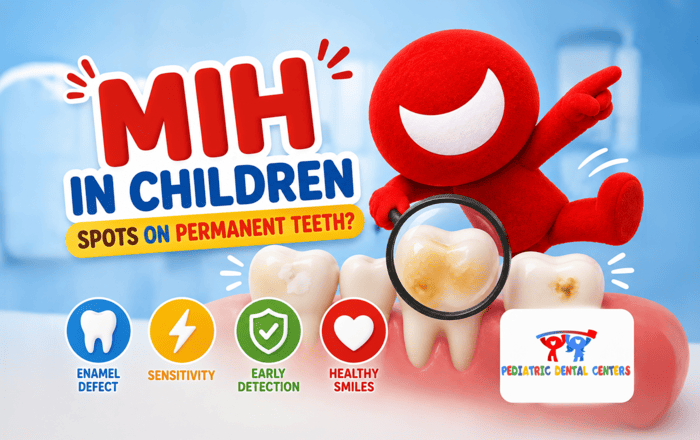
A permanent tooth has just erupted, but instead of looking uniformly white, part of it appears creamy white, yellow, or even brown. Parents understandably wonder: Is it a cavity? Did my child fail to brush properly? Is the tooth permanently damaged?
One possible explanation is molar-incisor hypomineralization, commonly abbreviated as MIH.
MIH is a developmental enamel condition that most commonly affects one or more of the first permanent molars and may also affect the permanent incisors. Because the first permanent molars generally erupt at approximately age six, the condition can become apparent relatively early in childhood.
Recognizing MIH is important because affected teeth may require additional preventive care and, in more severe cases, restorative treatment.
What Is Molar-Incisor Hypomineralization?
Enamel is the hard outer layer that protects a tooth. Normally, developing enamel becomes highly mineralized and strong.
In a tooth affected by MIH, portions of the enamel have not mineralized normally during tooth development. The affected enamel may therefore have different color, strength, porosity, or sensitivity compared with normal enamel.
MIH primarily involves permanent teeth and is different from ordinary plaque-related tooth decay.
What Does MIH Look Like?
The appearance varies considerably.
Parents may notice a clearly defined area on a newly erupted permanent tooth that appears:
- Chalky or creamy white
- Yellow
- Yellow-brown
- Brown
These areas are known as demarcated opacities because there is usually a recognizable border between affected and normal enamel.
In mild cases, the tooth may simply look different.
In more significant cases, the enamel can be weaker and may begin breaking down after the tooth erupts and is exposed to chewing forces.
Is MIH the Same as a Cavity?
No.
MIH is a developmental enamel defect, while dental caries is a disease process involving bacterial activity, fermentable carbohydrates, acid production, and demineralization of tooth structure.
However, the two problems can become related.
Because severely affected MIH enamel may be porous or weak, plaque can accumulate in irregular areas and the enamel may break down. This can make the tooth more difficult to clean and potentially more vulnerable to developing cavities.
For this reason, early diagnosis can be valuable.
Why Does MIH Happen?
The precise cause of MIH is not completely understood.
Researchers have investigated numerous possible factors occurring during the period when permanent teeth are developing. MIH appears to have a multifactorial origin rather than one simple universal cause.
Parents should understand an important point:
MIH does not mean that a parent failed to brush a child’s teeth or that the child consumed too much sugar while the affected permanent tooth was erupting.
The enamel abnormality developed while the tooth itself was forming.
Once the tooth erupts, however, excellent oral hygiene, appropriate fluoride exposure, dietary control and professional dental care become particularly important.
Why Can MIH Teeth Be Sensitive?
Sensitivity is one of the more challenging aspects of MIH.
Some affected children experience discomfort when the tooth is exposed to:
- Cold water
- Cold air
- Toothbrushing
- Certain foods
- Dental procedures
A child may therefore avoid brushing the affected tooth because brushing hurts.
Unfortunately, inadequate brushing can then increase plaque accumulation and the risk of dental disease.
Parents should mention sensitivity to the pediatric dentist rather than assuming the child is simply resisting brushing.
Why Early Detection Matters
The first permanent molars are extremely important teeth.
Unlike primary molars, they are intended to remain throughout adulthood. Because they frequently erupt at approximately age six, parents sometimes mistake them for additional baby teeth.
A compromised first permanent molar deserves careful monitoring.
Early identification of MIH allows the pediatric dentist to evaluate the severity of the enamel defect and develop an individualized preventive or treatment strategy.
How Is MIH Treated?
Treatment depends on the tooth, severity of the defect, presence of sensitivity, amount of enamel breakdown, cavity risk, age of the child and other clinical factors.
Management may include:
Fluoride and Preventive Care
Professional fluoride applications may be recommended to help protect susceptible tooth surfaces and manage caries risk.
Desensitizing Strategies
Children experiencing sensitivity may benefit from specific preventive or desensitizing approaches recommended by their dentist.
Sealants
When appropriate, dental sealants can protect susceptible grooves and pits of permanent molars.
The pediatric dentist must first determine whether the enamel is suitable for predictable sealant placement.
Restorations
If enamel has broken down or a cavity has developed, a restoration may be necessary.
The choice of restorative material and technique depends upon the severity and location of the defect.
Crowns
More extensively affected molars sometimes require greater coverage to protect the remaining tooth structure.
Extraction and Orthodontic Planning
In severe cases, a first permanent molar may have such a poor long-term prognosis that extraction becomes a consideration.
This decision requires careful planning.
Timing can significantly influence how neighboring permanent teeth erupt and move. For that reason, severe cases may benefit from coordinated evaluation between the pediatric dentist and orthodontist before extraction is performed.
What About White Spots on the Front Teeth?
Not every white spot is MIH.
Changes in enamel color can have multiple causes, including developmental enamel defects, fluorosis, early demineralization associated with plaque, previous trauma affecting a developing permanent tooth, and other conditions.
A photograph or visual description alone may not be sufficient to determine the cause.
A pediatric dentist can examine the location, borders, texture and distribution of the discoloration and consider the child’s dental and medical history.
What Can Parents Do at Home?
If your child’s newly erupted permanent teeth have unusual white, yellow or brown areas:
- Do not assume the tooth is dirty.
- Do not aggressively scrub or attempt to remove the discoloration.
- Maintain twice-daily brushing with an age-appropriate fluoride toothpaste.
- Pay particular attention to newly erupted permanent molars.
- Limit frequent exposure to sugary drinks and snacks.
- Tell the dentist if the child reports sensitivity.
- Keep recommended preventive dental appointments.
Children with compromised enamel may require a preventive schedule tailored to their individual risk.
The Importance of the Age-Six Molars
Parents should begin watching for permanent molars around age six.
These teeth erupt behind the last primary molars rather than replacing baby teeth. Consequently, parents may not immediately realize that these are permanent teeth.
Once they begin erupting, they should be brushed carefully from the beginning.
If one looks dramatically whiter, yellower or browner than the others—or if your child complains that brushing or cold water hurts—ask your pediatric dentist to evaluate it.
Pediatric Dentists Can Identify Enamel Problems Early
Pediatric dentistry focuses not only on treating existing disease but also on monitoring dental development.
Regular examinations provide an opportunity to identify newly erupted permanent teeth, assess enamel quality, evaluate caries risk and intervene before relatively small problems become more complicated.
For children with MIH, early diagnosis can be particularly useful because management can begin while the permanent molars are newly erupted.
Pediatric Dental Care in Miami-Dade and Broward
If you notice white, yellow or brown areas on your child’s permanent teeth, do not assume they are cavities—and do not ignore them.
A pediatric dental examination can help determine whether the discoloration represents MIH, another developmental enamel condition, early decay or another dental finding.
Pediatric Dental Centers provides pediatric dental care throughout Miami-Dade and Broward counties, with preventive, restorative and orthodontic services designed for children and adolescents.
Looking for a pediatric dentist in Miami or Broward? Contact Pediatric Dental Centers to schedule your child’s dental evaluation.