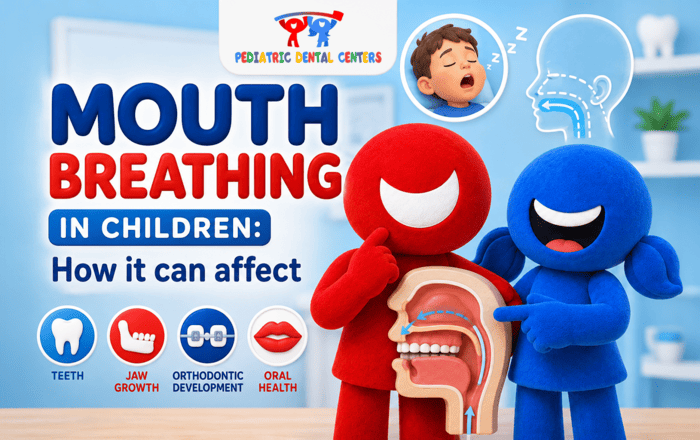
Muchos padres notan que su hijo duerme con la boca abierta, respira por la boca durante el día o se despierta con frecuencia con los labios y la boca secos. Respirar por la boca ocasionalmente durante un resfriado es común. Sin embargo, cuando la respiración bucal se vuelve persistente, puede ser conveniente consultarlo con el pediatra, el dentista pediátrico u otro profesional de la salud de su hijo.
La respiración bucal crónica puede afectar la salud oral y puede estar asociada con cambios en el desarrollo dental y facial. En Pediatric Dental Centers, nuestros equipos de odontología pediátrica y ortodoncia evalúan todo el entorno oral, no solamente si el niño tiene caries.
¿Por qué algunos niños respiran por la boca?
Normalmente, los niños respiran principalmente por la nariz. La respiración bucal puede desarrollarse cuando respirar por la nariz se vuelve difícil o cuando el niño adopta un patrón persistente de respiración por la boca.
Entre las posibles causas se incluyen:
- Congestión nasal causada por alergias o infecciones respiratorias frecuentes
- Amígdalas o adenoides agrandadas
- Amígdalas o adenoides agrandadas
- Problemas crónicos de los senos paranasales o de la nariz
- Respiración bucal habitual
- Ciertos patrones de desarrollo facial o mandibular
Debido a que diversas condiciones médicas y dentales pueden contribuir a este problema, es importante identificar la causa subyacente.
Un dentista pediátrico puede reconocer hallazgos orales que podrían estar asociados con la respiración bucal, pero determinar la causa puede requerir una evaluación por parte del pediatra del niño, un especialista en oído, nariz y garganta (otorrinolaringólogo u ORL), un alergólogo u otro profesional de la salud apropiado.
Respiración bucal y boca seca
Uno de los efectos dentales más directos de la respiración bucal es la disminución de la humedad en la boca.
La saliva cumple varias funciones importantes. Ayuda a eliminar restos de alimentos, neutraliza los ácidos producidos por las bacterias, protege los tejidos de la boca y favorece la remineralización natural del esmalte dental.
Cuando la boca de un niño permanece abierta durante períodos prolongados, especialmente durante la noche, los dientes y las encías pueden resecarse.
La sequedad bucal persistente puede contribuir a:
- Mayor acumulación de placa
- Mal aliento
- Encías irritadas o inflamadas
- Mayor susceptibilidad a las caries en algunos niños
- Labios secos o agrietados
Por lo tanto, un niño que se despierta constantemente con la boca muy seca puede beneficiarse de una evaluación.
¿Puede la respiración bucal afectar las encías?
Sí. Los niños que respiran por la boca pueden desarrollar inflamación gingival, especialmente alrededor de los dientes frontales superiores.
Las encías pueden verse rojas, hinchadas o irritadas incluso cuando la higiene bucal parece ser razonablemente buena. La sequedad de los tejidos orales puede contribuir a esta inflamación.
En ocasiones, los padres asumen que el sangrado o el enrojecimiento de las encías siempre significa que el niño no se está cepillando adecuadamente. La higiene oral es, sin duda, importante, pero la respiración bucal persistente también puede ser un factor que contribuya al problema.
En ocasiones, los padres asumen que el sangrado o el enrojecimiento de las encías siempre significa que el niño no se está cepillando adecuadamente. La higiene oral es, sin duda, importante, pero la respiración bucal persistente también puede ser un factor que contribuya al problema.
Los padres preguntan con frecuencia si respirar por la boca puede cambiar la cara o la mandíbula de un niño.
El crecimiento facial es complejo y está influenciado por la genética, la función muscular, las condiciones de las vías respiratorias, los hábitos orales y muchos otros factores. La respiración bucal crónica se ha asociado con determinados patrones de desarrollo dentofacial, pero no debe considerarse automáticamente como la causa de una condición facial u ortodóntica específica.
Cuando un niño mantiene constantemente la boca abierta, la posición de reposo de la lengua, los labios y la mandíbula puede ser diferente de la que se presenta con una respiración nasal normal.
Con el tiempo, algunos niños con respiración bucal persistente también pueden presentar hallazgos ortodónticos como:
- Un arco dental superior estrecho
- Resalte dental aumentado
- Mordida abierta
- Mordida cruzada
- – Apiñamiento dental
- Posición alterada de la lengua
- Dificultad para mantener los labios cerrados de manera natural
Estos hallazgos no se presentan en todos los niños que respiran por la boca y también pueden aparecer por causas no relacionadas con la respiración.
Por qué es importante la posición de la lengua
Cuando la boca está cerrada y el niño respira cómodamente por la nariz, la lengua normalmente descansa en una posición que interactúa con los dientes y las mandíbulas en desarrollo.
Un niño que mantiene frecuentemente la boca abierta puede colocar la lengua de manera diferente. Debido a que la lengua, las mejillas y los labios ejercen continuamente fuerzas suaves sobre los arcos dentales en desarrollo, los patrones de reposo anormales pueden ser relevantes durante el crecimiento.
Esta es una de las razones por las que los dentistas pediátricos y los ortodoncistas pueden preguntar sobre los hábitos respiratorios al evaluar la mordida de un niño.
¿Qué ocurre con los ronquidos?
Los ronquidos frecuentes merecen atención.
No todos los niños que roncan tienen un problema médico importante, pero los ronquidos habituales, las pausas en la respiración, los jadeos durante el sueño, el sueño inquieto, las posiciones inusuales al dormir o la somnolencia significativa durante el día y los cambios de comportamiento deben comentarse con el pediatra del niño.
Los dentistas pueden ayudar a identificar hallazgos orales y craneofaciales que puedan justificar una evaluación adicional, pero no sustituyen la valoración de un médico ante un posible trastorno respiratorio relacionado con el sueño.
¿Cuándo deberían los padres considerar una evaluación ortodóntica?
La American Association of Orthodontists recomienda realizar una primera evaluación ortodóntica aproximadamente a los siete años.
Esto no significa que todos los niños de siete años necesiten brackets.
Sin embargo, a esta edad, el niño generalmente tiene una combinación de dientes temporales y permanentes. Un ortodoncista puede evaluar la relación entre las mandíbulas, los patrones de erupción, el apiñamiento, las mordidas cruzadas, las mordidas abiertas y otras condiciones que se estén desarrollando.
Cuando la respiración bucal persistente está acompañada de un arco superior estrecho, mordida cruzada, apiñamiento significativo, una mordida anormal u otros hallazgos del desarrollo, una evaluación ortodóntica puede ayudar a determinar si lo más adecuado es observar la evolución o iniciar un tratamiento.
¿Un expansor corrige la respiración bucal?
No necesariamente.
Un expansor ortodóntico puede estar indicado para ciertas condiciones ortodónticas, como determinados déficits transversales o mordidas cruzadas. No debe indicarse automáticamente simplemente porque un niño respira por la boca.
La primera pregunta debe ser por qué el niño está respirando por la boca.
Si las amígdalas o adenoides agrandadas, las alergias u otra condición médica están contribuyendo a la obstrucción de las vías respiratorias, ese problema subyacente puede requerir una evaluación por parte del profesional médico correspondiente.
Con frecuencia, el mejor enfoque es interdisciplinario.
Señales a las que los padres deben estar atentos
Considere hablar sobre síntomas persistentes con los profesionales de la salud de su hijo si observa:
- Duerme con la boca abierta la mayoría de las noches
- Duerme con la boca abierta la mayoría de las noches
- Tiene congestión nasal crónica
- Presenta boca seca al despertar
- Tiene mal aliento persistente
- Labios secos o agrietados
- Tiene encías rojas o irritadas
- Tiene dificultad para cerrar los labios cómodamente
- Presenta un arco dental estrecho
- Tiene mordida cruzada o mordida abierta
- Presenta apiñamiento dental significativo
- Tiene cambios al masticar o en la mordida
- Existen preocupaciones sobre la calidad de su sueño
Ningún síntoma por sí solo permite establecer un diagnóstico. Lo importante es el patrón de los síntomas y su persistencia.
Cómo trabajan en conjunto Ortodoncia y la ortodoncia
La salud oral de los niños implica mucho más que tratar las caries.
Un examen dental pediátrico integral permite evaluar los dientes, las encías, la erupción dental, la higiene oral, el desarrollo de la mordida y otros hallazgos de la boca. Cuando se identifican preocupaciones ortodónticas, la colaboración con un ortodoncista puede ayudar a determinar si es necesaria una intervención y cuál es el momento adecuado para iniciar el tratamiento.
Si se considera necesaria una evaluación médica, el niño también puede ser remitido a un pediatra, un especialista en oído, nariz y garganta (otorrinolaringólogo) u otro profesional de la salud.
Este enfoque coordinado es especialmente importante porque la respiración bucal puede tener componentes dentales, ortodónticos y médicos.
Atención odontológica pediátrica y ortodóntica en Miami y Broward
Si su hijo duerme regularmente con la boca abierta, ronca, presenta sequedad bucal persistente o parece estar desarrollando problemas en la mordida o la mandíbula, considere comentar estas observaciones durante su próximo examen dental.
Pediatric Dental Centers ofrece servicios de odontología pediátrica y ortodoncia para niños y adolescentes en los condados de Miami-Dade y Broward.
Un dentista pediátrico u ortodoncista puede evaluar la salud oral y el desarrollo dental de su hijo y determinar si puede ser necesaria una evaluación adicional.
¿Está buscando un dentista pediátrico en Miami o Broward, o un ortodoncista en Miami o Broward? Comuníquese con Pediatric Dental Centers para programar una evaluación.
Este artículo tiene fines educativos generales y no sustituye un diagnóstico ni un tratamiento dental o médico individualizado.