Cuando los padres escuchan que su hijo necesita una corona de acero inoxidable, es común que tengan preguntas. ¿Dolerá? ¿Es seguro? ¿Por qué no se puede simplemente hacer un empaste? En Pediatric Dental Centers, estas son algunas de las inquietudes más comunes que escuchamos de las familias de todo Miami-Dade y el condado de Broward.
La buena noticia es que las coronas de acero inoxidable se han utilizado de forma segura y exitosa en la odontología pediátrica durante décadas. Son una de las maneras más duraderas y eficaces de restaurar dientes de leche gravemente dañados, ayudando a que los niños conserven sus dientes naturales sanos hasta que estén listos para caerse de forma natural.
Si a su hijo le han dicho que podría necesitar una corona de acero inoxidable, aquí tiene todo lo que necesita saber.
¿Qué es una corona de acero inoxidable?
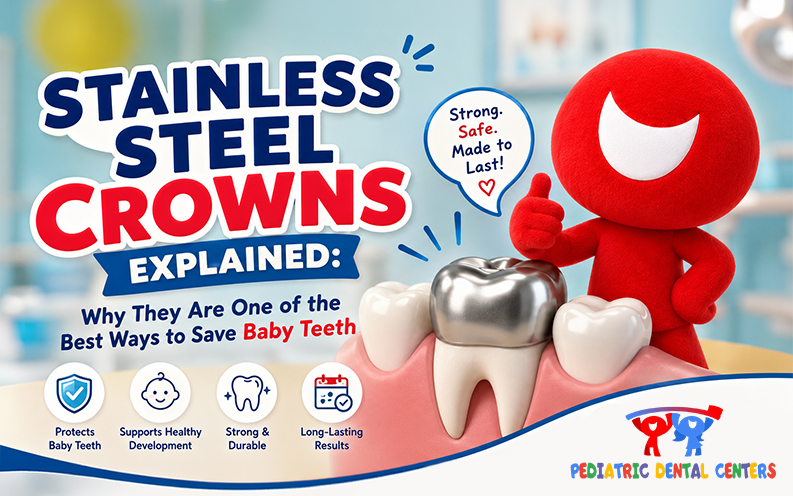
Una corona de acero inoxidable es una cubierta metálica prefabricada que cubre por completo un diente de leche dañado o debilitado. A diferencia de un empaste, que repara solo una parte del diente, una corona protege todo el diente de daños adicionales.
Su dentista pediátrico ajusta la corona a la medida y la cementa de forma permanente, creando una restauración fuerte y duradera que permite a su hijo masticar, hablar y sonreír con comodidad.
Como los dientes de leche se caen de forma natural con el tiempo, las coronas de acero inoxidable ofrecen una solución ideal a largo plazo sin necesidad de procedimientos más complejos.
¿Por qué son tan importantes los dientes de leche?
Algunos padres suponen que, como los dientes de leche se caen con el tiempo, no es necesario tratarlos. En realidad, los dientes de leche cumplen varias funciones esenciales en el crecimiento y desarrollo de su hijo.
Los dientes de leche sanos ayudan a los niños a:
- Masticar los alimentos con comodidad
- Hablar con claridad
- Mantener una nutrición adecuada
- Favorecer el desarrollo normal de los maxilares
- Guían a los dientes permanentes a la posición correcta
- Conservar espacio para los dientes permanentes
Perder un diente de leche demasiado pronto puede aumentar el riesgo de apiñamiento, problemas de mordida y la necesidad de un tratamiento ortodóntico en el futuro.
¿Cuándo necesita un niño una corona de acero inoxidable?
No todas las caries requieren una corona. Las áreas pequeñas de caries a menudo pueden repararse con empastes del color del diente.
Sin embargo, su dentista pediátrico puede recomendar una corona de acero inoxidable cuando:
- La caries es muy grande.
- Se ha perdido la mayor parte de la estructura del diente.
- El diente se ha fracturado.
- Se ha realizado una pulpotomía (tratamiento de conducto en un diente de leche).
- El niño tiene un alto riesgo de desarrollar más caries.
- El diente tiene varias superficies afectadas por caries.
En estas situaciones, un empaste por sí solo puede no ofrecer la resistencia suficiente para proteger el diente.
¿Por qué no colocar simplemente un empaste?
Los empastes grandes en los dientes de leche a veces pueden fallar porque no queda suficiente diente sano que los sostenga.
Cuando los niños mastican, rechinan y muerden alimentos duros, los empastes grandes pueden agrietarse, aflojarse o salirse. Esto puede provocar más caries, molestias o incluso la pérdida prematura del diente.
Una corona de acero inoxidable rodea por completo el diente y ofrece una protección y una durabilidad notablemente mayores.
Muchos estudios han demostrado que las coronas de acero inoxidable tienen una mayor tasa de éxito a largo plazo que los empastes grandes en los molares primarios.
¿Cómo se coloca una corona de acero inoxidable?
A los padres a menudo los sorprende lo sencillo que es el procedimiento.
El proceso generalmente consta de estos pasos:
- Adormecer el diente con anestesia local.
- Retirar la parte cariada del diente.
- Remodelar ligeramente el diente.
- Seleccionar la corona del tamaño adecuado.
- Ajustar el encaje.
- Cementar la corona de forma permanente.
En muchos casos, todo el procedimiento puede completarse en una sola visita.
En Pediatric Dental Centers, nuestros dentistas pediátricos con experiencia se enfocan en que cada niño se sienta cómodo y relajado durante todo el tratamiento.
¿Sentirá dolor mi hijo?
La mayoría de los niños siente poca o ninguna molestia durante el procedimiento porque el diente se adormece por completo antes de que comience el tratamiento.
Después de la cita, es normal sentir una leve sensibilidad durante uno o dos días, pero esta suele desaparecer rápidamente.
La mayoría de los niños vuelve a comer con normalidad y a realizar sus actividades diarias poco después.
¿Son seguras las coronas de acero inoxidable?
Sí.
Las coronas de acero inoxidable se han utilizado de forma segura en la odontología pediátrica durante más de 70 años y siguen siendo uno de los materiales restauradores más ampliamente estudiados para los dientes de los niños.
Estas coronas son:
- Fuertes
- Duraderas
- Biocompatibles
- De larga duración
- Resistentes a las fracturas
En los niños con caries extensas, a menudo ofrecen el resultado más predecible a largo plazo.
¿Cuánto duran las coronas de acero inoxidable?
En la mayoría de los casos, la corona permanece en su lugar hasta que el diente de leche se cae de forma natural.
Muchas coronas funcionan con éxito durante varios años sin necesidad de reemplazo.
Su excepcional durabilidad es una de las razones por las que los dentistas pediátricos las recomiendan con tanta frecuencia para los molares primarios.
¿Afectará la corona la alimentación de mi hijo?
Al principio, es posible que su hijo note que la corona se siente diferente simplemente porque es nueva.
En unos pocos días, la mayoría de los niños se adapta por completo.
Una vez que el diente ha sanado, los niños generalmente pueden comer con normalidad.
Su dentista pediátrico puede recomendar evitar los caramelos pegajosos, masticar hielo o los alimentos muy duros para ayudar a proteger todas las restauraciones dentales.
¿Notarán los demás niños la corona?
Las coronas de acero inoxidable se colocan con mayor frecuencia en los dientes posteriores, donde rara vez se ven al sonreír o hablar normalmente.
Como están ubicadas en la parte posterior de la boca, la mayoría de los niños —y sus amigos— casi no las notan.
Para los dientes frontales, los dentistas pediátricos suelen recomendar alternativas estéticas, como las coronas del color del diente.
¿Cómo pueden ayudar los padres a que las coronas duren más?
Una buena higiene bucal sigue siendo esencial.
Los padres deben animar a los niños a:
- Cepillarse los dientes dos veces al día.
- Usar hilo dental todos los días.
- Limitar los refrigerios y las bebidas azucaradas.
- Asistir a chequeos dentales regulares.
- Recibir tratamientos preventivos con flúor cuando se recomiende.
Aunque la corona en sí no puede desarrollar caries, el diente natural que está debajo aún puede dañarse si se acumula placa alrededor de los bordes.
Preguntas frecuentes (FAQ):
¿Se pueden caer las coronas de acero inoxidable?
Es poco común, pero las coronas pueden aflojarse ocasionalmente si el diente subyacente cambia o si los alimentos pegajosos tiran de la corona. Si esto ocurre, comuníquese con su dentista pediátrico de inmediato.
¿Puede mi hijo comer con normalidad?
Sí. Después del período de adaptación inicial, la mayoría de los niños vuelve a su dieta habitual.
¿Están cubiertas las coronas de acero inoxidable por el seguro?
Muchos planes de seguro dental y programas de Medicaid de Florida cubren las coronas de acero inoxidable cuando son médicamente necesarias. La cobertura varía según el plan, por lo que nuestro equipo con gusto ayuda a las familias a entender sus beneficios antes del tratamiento.
¿Contienen mercurio las coronas de acero inoxidable?
No. Las coronas de acero inoxidable no contienen mercurio.
Por qué las familias de todo Miami y Broward confían en Pediatric Dental Centers
En Pediatric Dental Centers, nuestros dentistas pediátricos certificados se comprometen a preservar las sonrisas de los niños siempre que sea posible. Utilizamos tratamientos basados en la evidencia, técnicas amigables para los niños y tecnología avanzada para ayudar a que cada paciente reciba la atención que necesita en un entorno cómodo.
Ya sea que su hijo tenga una caries pequeña o requiera un tratamiento más extenso, nuestro equipo con experiencia le explicará cada opción y responderá a sus preguntas para que usted pueda tomar decisiones informadas con confianza.
Con múltiples ubicaciones convenientes en todo Miami-Dade y el condado de Broward, atendemos con orgullo a bebés, niños, adolescentes y pacientes con necesidades especiales de atención médica.
Programe hoy la visita dental de su hijo
Si a su hijo le han dicho que podría necesitar una corona de acero inoxidable —o si simplemente desea una segunda opinión—, nuestro equipo está aquí para ayudarle.
En Pediatric Dental Centers, creemos que conservar los dientes de leche siempre que sea posible favorece un crecimiento saludable, una alimentación cómoda, un desarrollo adecuado del habla y la salud bucal de por vida.
Comuníquese con una de nuestras convenientes ubicaciones de Pediatric Dental Centers que atienden a Miami, Miami Gardens, West Kendall, Palmetto Bay, Homestead, Miami Shores, Liberty City, River Landing, North Lauderdale, Lauderhill, así como a familias de todo el condado de Broward y programe una cita con un dentista pediátrico de confianza en Miami o Broward. Juntos, podemos mantener la sonrisa de su hijo sana, fuerte y en crecimiento durante muchos años.